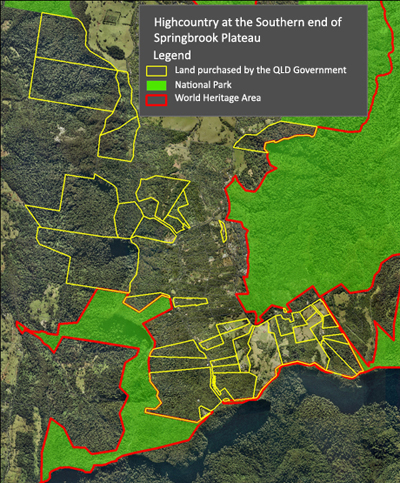
To date, the Queensland Government has purchased more than 700 hectares of land at Springbrook, mainly in the high country at the southern end of the Plateau. There are two principal factors driving the acquisitions:
- The high country, largely above 800 metres, is very significant for conservation. There is high rainfall and the ridges and valleys are frequently immersed in cloud. The rainforests in this area — cloud forests — are among the most threatened ecosystems with respect to climate change.
- Springbrook National Park, part of the Gondwana Rainforests of Australia World Heritage Area, is too small and its boundaries are very poorly configured and not conducive to long-term viability. It is important that the national park be expanded and that its currently isolated parts be linked.
The first acquisitions occurred in 2005 when a number of properties with high conservation value came on the market. Funding was allocated under the South East Queensland Conservation Initiative. In 2006, Premier Peter Beattie committed a further $15 million to continue the acquisition programme.
ARCS was asked to provide assessments of the conservation values, especially World Heritage values, of properties that came up for sale. Having prepared the World Heritage nomination of the area, ARCS was in an ideal position to provide the assessments. ARCS received no payment for the work which involved extensive flora and fauna surveys.
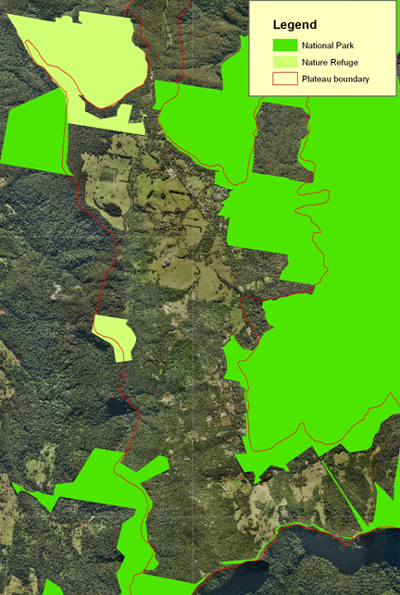
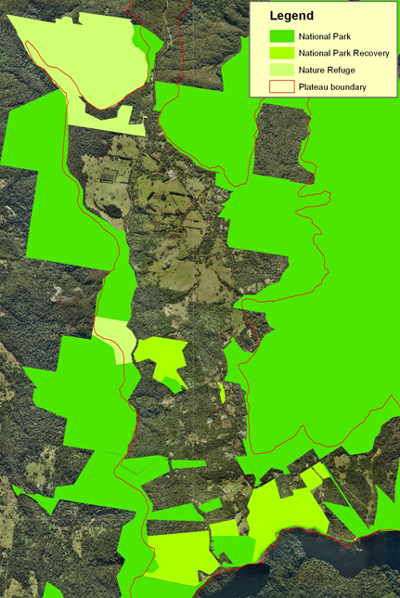
It can be seen from the map that the acquisitions have had a significant impact on fragmentation of the national park. It can also be seen that some of the acquired properties are cleared or largely cleared. These are the focus of the ‘Restoration’ component of Springbrook Rescue.
Ensuring long-term protection is best served by National Park tenure. Increasingly, however, private initiatives either as dedicated reserves or life-long strictly binding covenants are providing a reasonably secure option. |